Sunday Review New York Times.
OPINION
How to Think About the Risk of Autism
By SAM WANG
MARCH 29, 2014
A STUDY published last week found that the brains of autistic children show abnormalities that are likely to have arisen before birth, which is consistent with a large body of previous evidence. Yet most media coverage focuses on vaccines, which do not cause autism and are given after birth. How can we help people separate real risks from false rumors?
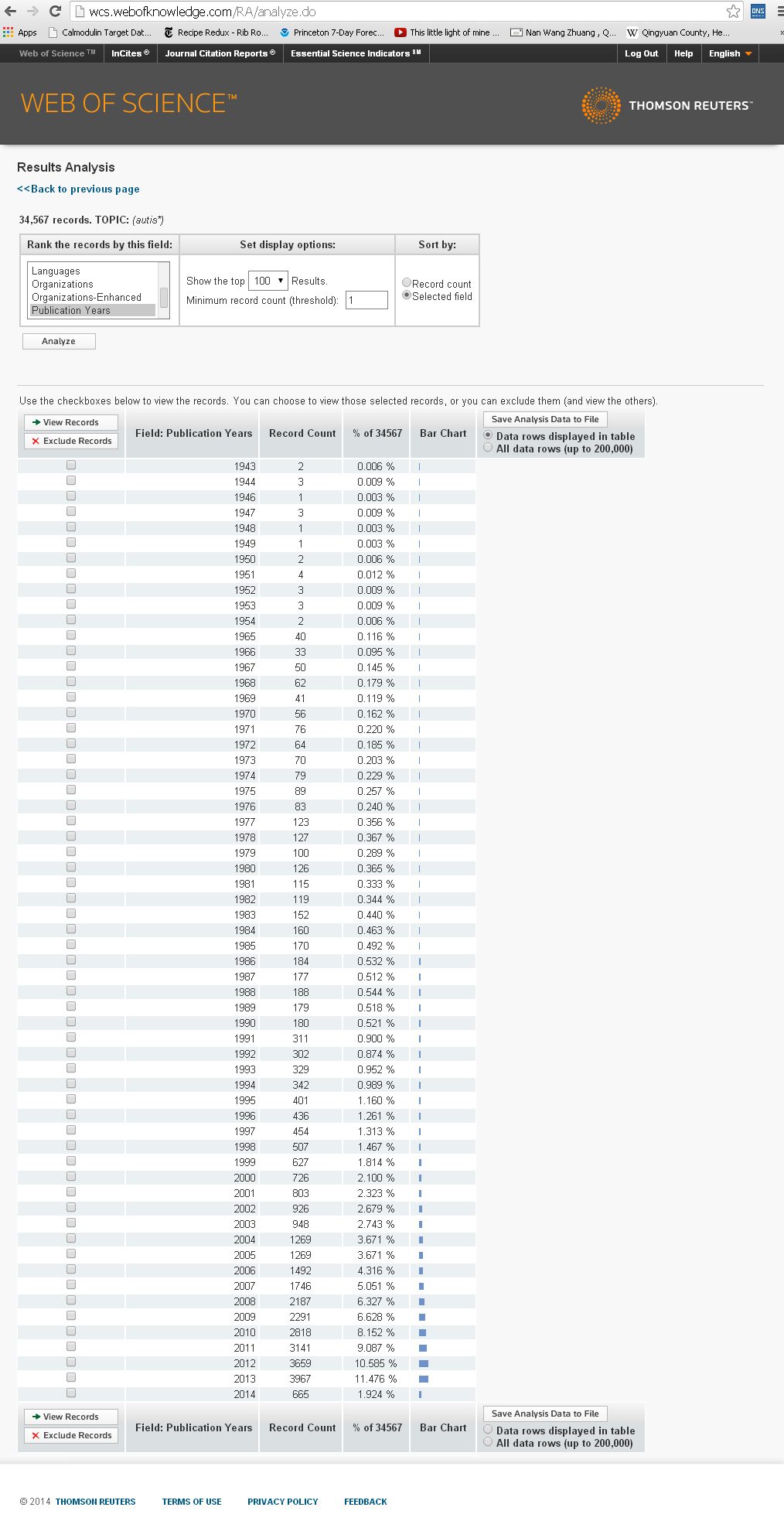
Over the last few years, we’ve seen an explosion of studies linking autism to a wide variety of genetic and environmental factors. Putting these studies in perspective is an enormous challenge. In a database search of more than 34,000 scientific publications mentioning autism since its first description in 1943, over half have come since 2008.
As a statistically minded neuroscientist, I suggest a different approach that relies on a concept we are familiar with: relative odds. As a single common measuring stick to compare odds, I have chosen the “risk ratio,” a measure that allows the bigger picture to come into focus.
For a variety of studies I asked the same question: How large is the increased risk for autism? My standard for comparison was the likelihood in the general population of autism spectrum disorder. Here’s an example. Start from the fact that the recorded rate of autism is now 1 in 68, according to a report released last week by the Centers for Disease Control and Prevention. If babies born in purple farmhouses have a rate of autism of 2 in 68, this doubling means that the purple farmhouse carries a risk ratio of 2. However, correlation is not causation, and there is no need to repaint that farmhouse just yet.
We can improve our chances of finding true causes by looking before the age of 2, when it becomes possible to diagnose autism. The risk ratio can give perspective where isolated news stories don’t. Media reports have focused on the risk associated with becoming a mother or father in one’s late 30s or after. The story has obvious appeal: Delayed parenthood is common, and readers are understandably anxious. However, parents-to-be should consider that the individual risk to the child is only around 1.4. The risk associated with enhanced or accelerated labor in full-term babies is about 1.2, after other complications are taken into account. And of course, the risk from vaccination is slightly less than 1 — there is no added risk. Even worse, incorrect beliefs about vaccines come with a cost. The return of measles in communities with falling vaccination rates is one recent example.
One might argue that any added risk is too much. But it is essential to put risk into perspective. The early research in the 1950s that first linked smoking with lung cancer gave a risk ratio around 25 for a pack-a-day smoker. In the case of autism, the risk associated with parental age is dwarfed by the impact of inheritance.
Comparing twins who grow up in the same environment allows researchers to focus on the effects of shared genes. A majority of children with an autistic identical twin are likely to be diagnosed with autism as well for a risk ratio somewhere around 80. A lower risk ratio comes from sharing half of one’s genes, as for fraternal twins or siblings. For these reasons, researchers believe that autism’s roots are largely genetic.
The human genome is dotted with hundreds of autism risk genes. Individually, each gene is usually harmless, and is in fact essential for normal function. This suggests that autism is caused by combinations of genes acting together. Think of genes as being like playing cards, and think of autism outcomes as depending on the entire hand. New mutations can also arise throughout life, which might account for the slightly greater risk associated with older fatherhood.
Although autism has a gene-based beginning, growing brains are also influenced by their environment and external events. Looking at when these risks are greatest can provide clues about when the growing brain is most vulnerable. Based on a large body of evidence, the known hazards occur before birth and fall into three broad categories: prematurity, prenatal stress and brain development.
MANY known risks for autism occur during late pregnancy and birth. Premature birth is a risk for developmental disability, including autism. Notably, elective cesarean section is associated with an autism risk ratio of 1.9. Since a substantial proportion of early deliveries are elective, without a compelling medical reason, this risk is preventable.
A highly underappreciated prenatal risk is stress. For pregnant women who take the sometimes-wrenching step of emigrating to a new country, for example, the risk ratio is 2.3. In the fifth through ninth months of pregnancy, getting caught in a hurricane strike zonecarries a risk ratio of about 3. Maternal post-traumatic stress disorder during pregnancy is associated with a similar effect. These events are likely to trigger the secretion of stress hormones, which can enter the fetus’s bloodstream and affect the developing brain for a lifetime. Stressors may also lead to maternal illness, the immune response to which may interfere with brain development.
Stress might account for other findings as well. Recent news coverage has speculated on the influence of air pollutants, which carry risk ratios around 1.4. This risk might be caused by chemicals — or by the stress of living in a poor or crowded neighborhood, where pollution is worse. A larger risk comes from households that already have an older sibling under 1 year of age, where newly conceived children have a risk ratio for autism of 3.4. So sure, parents should avoid smog — but also might think about spacing their children at judiciously chosen intervals.
After birth, known risks diminish. But the baby’s brain acquires a new need: social experience. In one group of Romanian orphanage children, babies were nearly isolated from social contact, and some later showed autism-like symptoms. Developing brains go through sensitive periods during which they require a minimum level of normal experience. Extreme deprivation may affect a critical period of the brain’s social and emotional development.
Risk ratios are good not just for parents, but also for researchers, who can follow them to new areas for in-depth study. The statistics suggest a conceptual framework in which fetal brain development stays on track unless it is driven awry by genetic hits, by adversity in late pregnancy, or a combination of the two.
In my laboratory, risk ratios have led us to examine particular brain regions. Many brain regions in autistic people show abnormalities, but it is not known whether some malfunctioning regions cause other regions to go off track. In one study focusing on detailed long-term outcomes in 51 children, damage to the cerebellum at birth leads to a risk ratio of about 40. The cerebellum links information arriving from different senses and communicates with nearly all regions of the cerebral cortex. Many known risk genes for autism are turned on together in the cerebellum in early life. Although cerebellum injury is rare, we think the cerebellum might be important in using sensory experience to guide normal brain development.
Looking at the problem of autism in terms of relative odds can provide a conceptual framework for understanding autism. For example, odds might help us understand why more children are being classified as autistic. Are the diagnostic criteria changing, or is the population changing as a result of stress and other risk factors?
Scientists do not agree on the answer to this question, but parents don’t need to worry too much about it. For them, the bottom line is reminiscent of an old piece of folk wisdom: Reduce stresses to the mother. And when reading or watching the news, remember that scare stories are not always what they seem. In this respect, looking at the hard data can help parents keep a cool head.


A STUDY published last week found that the brains of autistic children show abnormalities that are likely to have arisen before birth, which is consistent with a large body of previous evidence. Yet most media coverage focuses on vaccines, which do not cause autism and are given after birth. How can we help people separate real risks from false rumors?
Over the last few years, we’ve seen an explosion of studies linking autism to a wide variety of genetic and environmental factors. Putting these studies in perspective is an enormous challenge. In a database search of more than 34,000 scientific publications mentioning autism since its first description in 1943, over half have come since 2008.
As a statistically minded neuroscientist, I suggest a different approach that relies on a concept we are familiar with: relative odds. As a single common measuring stick to compare odds, I have chosen the “risk ratio,” a measure that allows the bigger picture to come into focus.
For a variety of studies I asked the same question: How large is the increased risk for autism? My standard for comparison was the likelihood in the general population of autism spectrum disorder. Here’s an example. Start from the fact that the recorded rate of autism is now 1 in 68, according to a report released last week by the Centers for Disease Control and Prevention. If babies born in purple farmhouses have a rate of autism of 2 in 68, this doubling means that the purple farmhouse carries a risk ratio of 2. However, correlation is not causation, and there is no need to repaint that farmhouse just yet.
We can improve our chances of finding true causes by looking before the age of 2, when it becomes possible to diagnose autism. The risk ratio can give perspective where isolated news stories don’t. Media reports have focused on the risk associated with becoming a mother or father in one’s late 30s or after. The story has obvious appeal: Delayed parenthood is common, and readers are understandably anxious. However, parents-to-be should consider that the individual risk to the child is only around 1.4. The risk associated with enhanced or accelerated labor in full-term babies is about 1.2, after other complications are taken into account. And of course, the risk from vaccination is slightly less than 1 — there is no added risk. Even worse, incorrect beliefs about vaccines come with a cost. The return of measles in communities with falling vaccination rates is one recent example.
One might argue that any added risk is too much. But it is essential to put risk into perspective. The early research in the 1950s that first linked smoking with lung cancer gave a risk ratio around 25 for a pack-a-day smoker. In the case of autism, the risk associated with parental age is dwarfed by the impact of inheritance.
Comparing twins who grow up in the same environment allows researchers to focus on the effects of shared genes. A majority of children with an autistic identical twin are likely to be diagnosed with autism as well for a risk ratio somewhere around 80. A lower risk ratio comes from sharing half of one’s genes, as for fraternal twins or siblings. For these reasons, researchers believe that autism’s roots are largely genetic.
The human genome is dotted with hundreds of autism risk genes. Individually, each gene is usually harmless, and is in fact essential for normal function. This suggests that autism is caused by combinations of genes acting together. Think of genes as being like playing cards, and think of autism outcomes as depending on the entire hand. New mutations can also arise throughout life, which might account for the slightly greater risk associated with older fatherhood.
Although autism has a gene-based beginning, growing brains are also influenced by their environment and external events. Looking at when these risks are greatest can provide clues about when the growing brain is most vulnerable. Based on a large body of evidence, the known hazards occur before birth and fall into three broad categories: prematurity, prenatal stress and brain development.
MANY known risks for autism occur during late pregnancy and birth. Premature birth is a risk for developmental disability, including autism. Notably, elective cesarean section is associated with an autism risk ratio of 1.9. Since a substantial proportion of early deliveries are elective, without a compelling medical reason, this risk is preventable.
A highly underappreciated prenatal risk is stress. For pregnant women who take the sometimes-wrenching step of emigrating to a new country, for example, the risk ratio is 2.3. In the fifth through ninth months of pregnancy, getting caught in a hurricane strike zonecarries a risk ratio of about 3. Maternal post-traumatic stress disorder during pregnancy is associated with a similar effect. These events are likely to trigger the secretion of stress hormones, which can enter the fetus’s bloodstream and affect the developing brain for a lifetime. Stressors may also lead to maternal illness, the immune response to which may interfere with brain development.
Stress might account for other findings as well. Recent news coverage has speculated on the influence of air pollutants, which carry risk ratios around 1.4. This risk might be caused by chemicals — or by the stress of living in a poor or crowded neighborhood, where pollution is worse. A larger risk comes from households that already have an older sibling under 1 year of age, where newly conceived children have a risk ratio for autism of 3.4. So sure, parents should avoid smog — but also might think about spacing their children at judiciously chosen intervals.
After birth, known risks diminish. But the baby’s brain acquires a new need: social experience. In one group of Romanian orphanage children, babies were nearly isolated from social contact, and some later showed autism-like symptoms. Developing brains go through sensitive periods during which they require a minimum level of normal experience. Extreme deprivation may affect a critical period of the brain’s social and emotional development.
Risk ratios are good not just for parents, but also for researchers, who can follow them to new areas for in-depth study. The statistics suggest a conceptual framework in which fetal brain development stays on track unless it is driven awry by genetic hits, by adversity in late pregnancy, or a combination of the two.
In my laboratory, risk ratios have led us to examine particular brain regions. Many brain regions in autistic people show abnormalities, but it is not known whether some malfunctioning regions cause other regions to go off track. In one study focusing on detailed long-term outcomes in 51 children, damage to the cerebellum at birth leads to a risk ratio of about 40. The cerebellum links information arriving from different senses and communicates with nearly all regions of the cerebral cortex. Many known risk genes for autism are turned on together in the cerebellum in early life. Although cerebellum injury is rare, we think the cerebellum might be important in using sensory experience to guide normal brain development.
Looking at the problem of autism in terms of relative odds can provide a conceptual framework for understanding autism. For example, odds might help us understand why more children are being classified as autistic. Are the diagnostic criteria changing, or is the population changing as a result of stress and other risk factors?
Scientists do not agree on the answer to this question, but parents don’t need to worry too much about it. For them, the bottom line is reminiscent of an old piece of folk wisdom: Reduce stresses to the mother. And when reading or watching the news, remember that scare stories are not always what they seem. In this respect, looking at the hard data can help parents keep a cool head.